Recorded August 25, 2026 · A Stride panel discussion, held online via Zoom · 11 minutes
What does it take to keep a family business entrepreneurial once the founder’s generation has moved on? For Stride’s August panel, How to Cultivate an Entrepreneurial Mindset for Lasting Family Success, we put that question to four people who have lived it — a serial founder, a sixth-generation shareholder of a global company, a second-generation operator who turned a spreadsheet into a software business, and Stride’s own founder — with a family business advisor facilitating. Originally planned for Jahnel Group’s headquarters in Schenectady, the session moved online so more of the community could join over lunch. The highlights are below, followed by a transcript of the highlights.
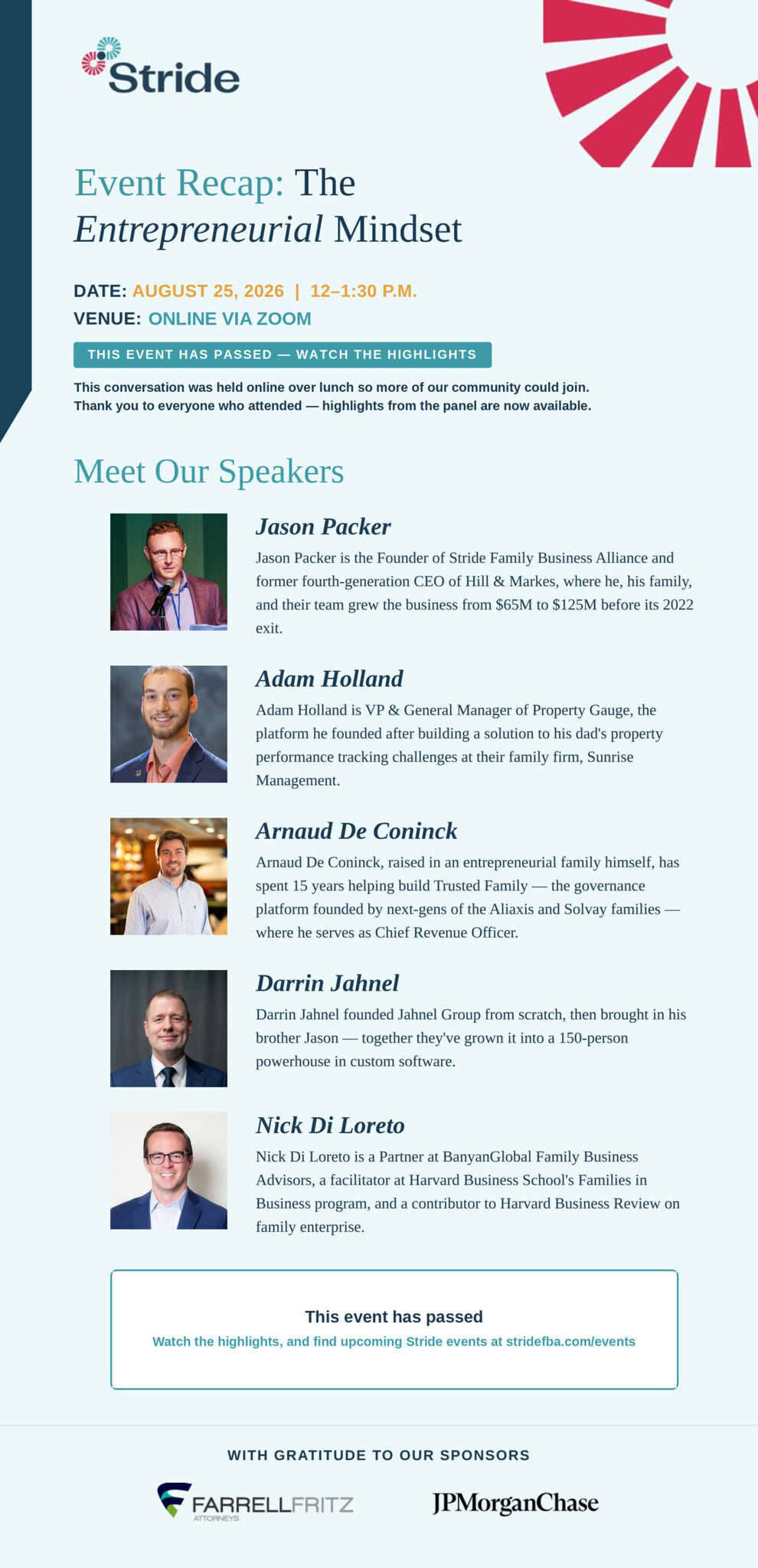
The panel
- Nick Di Loreto, facilitator — Partner, BanyanGlobal Family Business Advisors; a facilitator at Harvard Business School’s Families in Business program and a frequent writer on family business transitions.
- Arnaud De Coninck — raised in an entrepreneurial family and a sixth-generation member of the Solvay family; for 15 years he has helped build Trusted Family, the governance platform founded by next-gens of the Aliaxis and Solvay families, where he is Chief Revenue Officer.
- Adam Holland — second generation at Sunrise Management & Consulting in Latham, NY, where he is IT Director, and Vice President and General Manager of Property Gauge, the platform he founded after building a solution to his dad’s property performance tracking challenges at the family firm.
- Darrin Jahnel — founded Jahnel Group from scratch, then brought in his brother Jason; together they have grown it into a 150-person custom software firm in Schenectady, NY. He is also CEO of Logic Technology Inc.
- Jason Packer — Founder and CEO of Stride Family Business Alliance and former fourth-generation CEO of Hill & Markes, where he, his family, and their team grew the business from $65M to $125M before its 2022 exit.
What they said
Fourteen failed startups before a winner
Darrin Jahnel’s definition of entrepreneurship is not a romantic one: “a desire to start businesses and to constantly look to solve problems.” His brother and business partner and he had 14 failed startups before Jahnel Group. The one he tells is the education software that 11 of 12 schools said they would buy — after which he quit his job, moved his family from Manhattan to the Capital Region, closed zero of the eleven, and went a year without a sale and $70,000 into credit-card debt. He dug out by billing two full-time programming contracts at once, 80 hours a week, for 11 months.
If you live in America and you’re willing to hustle, you’re going to be okay.
Darrin Jahnel
Today he is starting a fourth company alone, writing the software with AI: “What I have done in the last four months would cost me probably a half a million dollars … I’ve probably spent $1,000 in tokens.”
A moonshot only a family could fund
Arnaud De Coninck chose Solar Impulse — the first solar-powered airplane to fly around the world — to explain what patient family capital makes possible. Solvay was a key partner, contributing some 50 products across more than 6,000 parts of the plane, in a program that ran a dozen years or more with no revenue line and no guaranteed payoff.
Only family shareholders that are anchored behind the business can really support such initiatives.
Arnaud De Coninck
The payoff was double: products that were in R&D then are performing for the company now, and the project became part of the family’s identity — “entrepreneurship needs a story, and it’s super important for those stories to be able to travel across generations.”
From a spreadsheet to a software company
Adam Holland’s entrepreneurship started with a problem in the family business. During COVID his father, who ran Sunrise Management’s rent payments, work orders, and leases “in his head,” handed the job to Adam. Adam built a spreadsheet, automated it so a color-coded report arrived every morning, and found that other operators in the industry wanted it too. It became Property Gauge; the morning of the panel he had just implemented the company’s third customer.
Growing through the crisis
When COVID hit Hill & Markes, the fourth-generation distribution business Jason Packer was running, the first instinct was to plan layoffs and cuts. His mother asked a different question: how can we grow? The company chased household-roll toilet paper and a million dollars of face masks — a shipment the Chinese government held at Shanghai’s airport after customers had already put money down — and scrambled to deliver anyway. The result was historic revenue and profit two years running.
Instead of thinking about cutting costs, we started thinking about growing customers, growing product lines, and finding new opportunities. It created a new muscle in the business.
Jason Packer
The four S’s of an entrepreneurial family
Facilitator Nick Di Loreto pulled the stories into a framework families can use to cultivate an entrepreneurial mindset in the next generation:
- Stories — tell the “oscillating narrative,” setbacks included, so the first failure doesn’t end a career.
- Structures — put policies and process in place so decisions are “process before people,” especially in second-, third-, and fourth-generation families where a yes to one sibling and a no to another breeds suspicion.
- Support — financial, but also connections, know-how, and mentorship, so the next generation knows entrepreneurship is a feasible path.
- Space — ask questions instead of giving answers, and let people chart their own path and make their own mistakes.
Advice for the next generation
- Darrin Jahnel: Never give up — pivot as often as you need to, but keep going until you find the one idea that works.
- Jason Packer: Keep adjusting. The customer is the decision-maker — “they’re your boss.”
- Adam Holland: Ask more questions. That’s how we learn.
- Arnaud De Coninck: Just go for it. Listen to your customers, connect with networks, and educate yourself by learning from peers.
Transcript
Read the transcript of the highlights (edited for readability, with speakers identified)
Jason Packer: I wanted to thank everybody for joining us this afternoon for our Stride panel discussion, with some incredibly successful family businesses on the call.
On what it means to be entrepreneurial
Darrin Jahnel: My brother is my business partner. Our parents were school teachers, so they were not entrepreneurial. The way I look at it, it’s really just a desire to start businesses and to constantly look to solve problems and do things. My brother and I had 14 failed startups before we got a winner, so it’s almost an obsession — something we can’t control. We’ve got a portfolio of three companies now, and I’m literally starting a fourth because I just can’t stop. It’s a compulsion. Fairly intense, but you’ll see that as a trend in my answers today.
Nick Di Loreto: Fourteen failed startups, or fourteen learning opportunities?
Darrin Jahnel: Fourteen learning opportunities, for sure — but definitely failures, let’s be real. Some of them were the worst companies you could ever imagine. But with each one we got a little better, a little smarter. A lot of pain.
On a moonshot only a family business could fund
Arnaud De Coninck: This brings me to a project called Solar Impulse, the first solar-powered plane to travel around the world with a pilot. Solvay was one of the key partners in the adventure: something like 50 different products across more than 6,000 parts of the plane. It was really a flying research lab, in development for 12, 13, 14 years, with no revenue line and no guaranteed payoff. There was clearly risk in all of this, and I think only family shareholders who are anchored behind the business can really support initiatives like that. I say it had two payoffs. One, it was successful: a lot of the products that were in research and development then are performing super well for the company today. But it has also been an identity project, something we’re proud to tell our kids about. Entrepreneurship needs a story. It’s super important to have the story, and for those stories to be able to travel across generations. This one did, which is why I chose it as an example.
On a spreadsheet that became a company
Adam Holland: Our business is property management. A couple of years ago, during COVID, my father came to me and said he was struggling to keep track of everything that needed to happen — rent payments, work orders, leases — and he was doing it all in his head. He decided he didn’t like that, so I was going to get to do it now, which was delightful. I made a spreadsheet to keep track of everything, because I knew I couldn’t do it in my head. He liked it, our team liked it, and I set it up to be automated so it came in every day, color-coded to show them exactly what they needed. We showed some other people in the industry, and they liked it too. So we decided to turn it into its own product. Three or four years later, I implemented our third customer — the first one to actually go somewhere — this morning.
On the start that almost broke him
Darrin Jahnel: That was probably our 12th company. We had built an educational software program and pitched it to 12 schools. We took a week of vacation from our full-time jobs, and 11 of the 12 said, “This is awesome. We’re going to buy it.” We were high-fiving in the parking lot: we’re going to be rich, this is easy. So I quit my job. We were living in Manhattan, and my wife had a good job; she quit hers because we were pregnant with our first child, and we moved to Upstate New York, about two hours north of the city in the Schenectady–Albany area. We bought a house. We’d both quit our jobs, but I was going to be rich, so no problem, right? Then I realized that just because someone says they want to buy something doesn’t mean you’re going to close the deal. I was young and naive. I didn’t understand the difference between a verbal “yeah, let’s do it” and actually getting money out of a school budget. We closed zero of those 11 verbal commitments and went a full year without selling anything. My wife and I ate through all of our savings and went $70,000 into credit card debt. That was my start: no job, 70 grand in debt, a house, a wife, and a baby. It was brutal. But I was a software engineer, so I took two full-time contracts and did them both for 11 months — 80 hours a week — and dug out of the debt. It’s a story about grit. If you live in America and you’re willing to hustle, you’re going to be okay.
On growing through a crisis
Jason Packer: We began to predict: okay, we’re probably going to have to lay people off, lower salaries, cut back. My mom’s perspective was, no — how can we grow? What could it look like if we decided we wanted to grow in this moment? It was a mindset shift more than anything else. Instead of thinking about cutting costs, we started thinking about growing customers, growing product lines, and finding new opportunities. We were on a phone call with China trying to get a million dollars’ worth of face masks. A large portion of it was on its way to America, sitting at the Shanghai airport ready to be put on a plane, and the Chinese government said, “No, those are our face masks.” We had already placed the orders with our customers; they had put money down. So we scrambled, found ways to bring products to people, and ended up growing the business — historic revenue, historic profit. The next year was the same. It created a new muscle in the business.
The four S’s of an entrepreneurial family
Nick Di Loreto: Number one — we’ve already talked about it — is stories, and this idea of the oscillating narrative. If everyone thinks everything is positive all the time and you’re trying to develop an entrepreneur, the first moment they have a setback they’ll fall by the wayside. So find the stories that tell that oscillating narrative. The second is structures: how do you put structures in place that enable decision-making and clarify opportunity, especially in families that are further along — second, third, fourth generation? Process before people. All too often in later-generation families, if Jason is my eldest and he’s the first to ask and we say yes, and then Arnaud is my second eldest and he asks and we say no — did we say no because we like Jason better than Arnaud? Probably not. But without a process or a policy in place, it’s easy for those misconceptions to take hold. Three is support: financial, perhaps, but also non-financial — connections, know-how, mentorship. How do you build those networks early, so your next generation or your employees know that entrepreneurship is a feasible path? And finally, space. I’m the father of three daughters, and I find it very hard not to give advice every time they come to me with a question. The most important thing I’ve learned is not to give the answer, but to ask questions and help them solve their own problems. The same holds for cultivating an entrepreneurial mindset: give people space to learn, to chart their own path and, perhaps most importantly, to make their own mistakes.
On starting a company in the age of AI
Darrin Jahnel: The ability to start a one-man company now has 100x’d your odds of success. The new company I’m starting, I’m literally doing by myself, using AI to write the software. I’m absolutely obsessed — back to 70-hour weeks — and it’s not possible without AI. What I’ve done in the last four months would have cost me probably half a million dollars, maybe 750K. I’ve done it for about $1,000 in tokens. It’s unbelievable.
Advice for the next generation
Nick Di Loreto: What piece of advice would you give them?
Darrin Jahnel: It goes to something Arnaud said: never give up. Now, you might need to give up on an idea and pivot — that’s hard to know, when to give up. But if you say, “This is what I’m going to do, and I never give up; I’ll just keep pivoting,” all you’ve got to do is find one successful idea.
Jason Packer: Keep adjusting. The original idea may end up being a completely different idea. Keep recognizing what your customers need and adjust to that, because they’re really the decision-makers — they’re your boss. Keep figuring out what they need and how you’re solving problems for them, making their lives easier, making things more seamless.
Adam Holland: Ask more questions. That’s how we learn.
Arnaud De Coninck: Just go for it. It’s so easy right now to start a business. Try it out. Listen to your customers — like Adam said, ask more questions. Connect with networks. And, as someone in the comments said, educate yourself: by connecting with networks, you meet peers and learn from peers.
This session was part of Stride’s monthly learning series, with gratitude to sponsors Farrell Fritz and JPMorganChase. See what’s coming up on the Events page, explore Stride’s programs and peer groups, or learn about membership.