
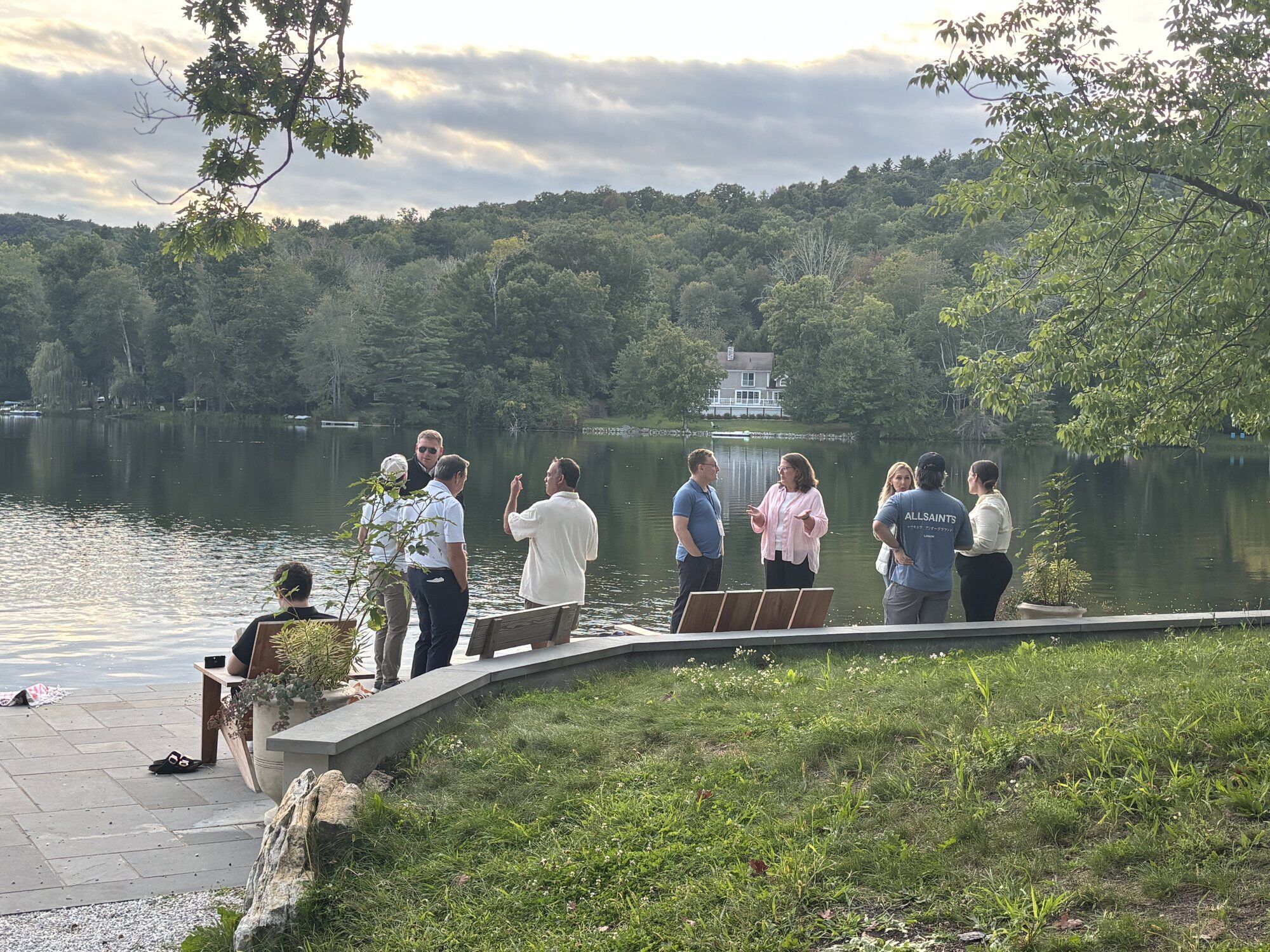
Adapted from remarks delivered by Jason Packer, Founder of Stride, at the welcome dinner of the 2nd Annual Family Enterprise Retreat — The Prospect Berkshires, Egremont, MA, September 8, 2026.
Good evening, and welcome to the Berkshires. I’m so excited to welcome you to our 2nd annual STRIDE retreat.
Before I go any further, I want to thank Christopher Walrath for finding this wonderful location. Thank you to the staff, who have been so accommodating, and thank you to Prospect Berkshires for opening the pavilion for our group. Such a beautiful location.
Having this group together is my dream. I believe that family businesses are the cornerstone of our economy. I believe that we need more space and connectivity for families to thrive. If they thrive, we will be impacted throughout the economy by strong values.
I want to let everyone know that one of the most important aspects of this community is inclusivity. I urge you all to get to know each other deeply. Do not let anyone stand alone without asking them what brings them to the Berkshires and finding something in common.
I also want to remind everyone: this is a confidential space. Whatever is said in the Berkshires stays in the Berkshires.
Also, we have all decided to spend our most valuable and scarce resource these next few days: time. We are here to connect, to reflect, to learn, and to leave our day-to-day at home for two and a half days.
I want to thank all of the speakers and facilitators we’ll be hearing from and guided by this week for their time and commitment to making this a special experience, and all our sponsors, whom I’ll thank at the end of this speech.
I want to start with a question that might seem out of place at a business retreat:
Why do grandmothers exist?
I’m serious. Humans are one of the only species on Earth that live long past their working years. Biologists call it the grandmother hypothesis: families with elders who stuck around — gathering food, sharing knowledge, helping raise the next generation — survived at higher rates than families without them.
Researchers studied farming families in pre-industrial Finland — the 1700s and 1800s, hard winters — and found that when a grandmother lived nearby and stayed engaged, her grandchildren’s survival rate went up thirty percent. A second study, of settler families in Quebec, found a grandmother’s presence meant one more grandchild per family survived to adulthood — and the farther away she lived, the more that advantage faded.
And it’s not just us. Orcas — killer whales — are one of the only other species on Earth with menopause. Scientists tracked 378 orca grandcalves. When a grandmother died, her grandcalves’ risk of death jumped more than four-fold. And here’s the detail I love: her impact was greatest when the salmon runs were low. When food was plentiful, the pod managed. When times got hard, the whole family depended on the one who remembered where the fish were. The matriarch matters most in the lean years. Every family enterprise in this room knows exactly what that means.
In other words: evolution selected for multigenerational families. The elder who stays engaged and transfers wisdom isn’t a luxury. It’s one of humanity’s winning adaptations.
Now — Charles Darwin, when he described evolution, used the phrase descent with modification.
Descent — you come from somewhere. You carry something forward. Modification — you are not a copy. You’re not supposed to be.
In nature, the offspring that’s an exact replica of its parent is not the safe bet — it’s the vulnerable one, because the environment is always changing. Variation is how a lineage survives. The next generation doing things differently isn’t a betrayal of the legacy. It’s how the legacy survives.
Descent and modification. Continuity and change. In evolution, they’re not enemies. One requires the other.
But — and here’s the catch — evolution doesn’t grade on legacy. It grades on adaptation. And that’s why you’re here. Every family in this room is running its own experiment in descent with modification. So over the next three days, I’m going to ask you to think about your own evolution on three horizons.
First: How will you evolve in this room, over these three days?
Evolution requires variation — exposure to something different. You’re about to hear from twelve speakers and sit beside families who’ve solved problems you’re still wrestling with, and wrestled with problems you thought were yours alone.
Second: How will you evolve after you leave?
The environment doesn’t reward the species that learns — it rewards the one that adapts. What’s one thing you will actually do differently when you walk back into your business next Monday? Not think about. Do.
Third: Who will you be five years from now — and what will your enterprise be because of it?
This is the big one. In five years, some of you will have handed something off. Some of you will have picked something up. Roles will shift, and if you do nothing, they’ll shift to you instead of by you. So I want you to picture it: five years out, what has your evolution made possible for your family and your enterprise? What did you carry forward — and what did you have the courage to modify?
Here’s what gives me hope about evolution: it doesn’t require perfection or genius. It requires small, persistent adaptations, compounding over time. That’s what families who last a hundred years actually do. Not one heroic decision. A thousand small ones.
So over the next three days: be the grandmother. Share what you know. And be the offspring, too — take what you inherit and make it fit the world that’s coming, not the world that was.
One more thing before we begin — because none of this happens on its own.
Fifteen sponsors made this retreat possible, and I want you to know what they actually gave — because it wasn’t just checks.
Farrell Fritz is our year-round partner — with Stride all twelve months, not just these three days. Morgan Stanley is hosting tomorrow night’s dinner at the Red Lion Inn — you’ll meet Martha and John at your tables. CFAR, Beacon Bank, Belden Hill Partners, and Captains Club stepped up so this retreat could be what it is.
Some gave something money can’t buy. The Family Business Consulting Group gave us the Karofskys. BanyanGlobal put the Harvard Business Review Family Business Handbook in your welcome bag. And Lisa Manning of EOS didn’t just agree to facilitate Thursday — she brought two of the families sitting in this room into this community.
Choice Words, Fraser Engineering, and LC Anderson are sponsoring and speaking. And three of our own member families — Albany Management, Phillips Hardware, and Walrath Recruiting — helped organize this retreat with their own hands.
Here’s what I want you to notice: our sponsors don’t stand at booths. They sit at the tables. Every one of them is here as a member of this community — so thank them the way you’d thank a member. Get to know them.
Welcome to the retreat.
Read how the three days unfolded: Recap: The 2026 Stride Retreat Exceeded All Expectations.